What is the Business Model?A business model is a strategic framework that outlines how a company plans to deliver and capture value in the market. It clarifies how a company’s products or services will fulfil customer needs, how it will compete with other businesses, and how it will sustain profitability over time.This is a significant factor contributing to the success of start-up companies, as it opens up long-term sustainable growth for the business. Let’s go through the most popular types of business models and see what we can learn. The Most Popular Types of Business Model
1. Razor and Blade Revenue Model
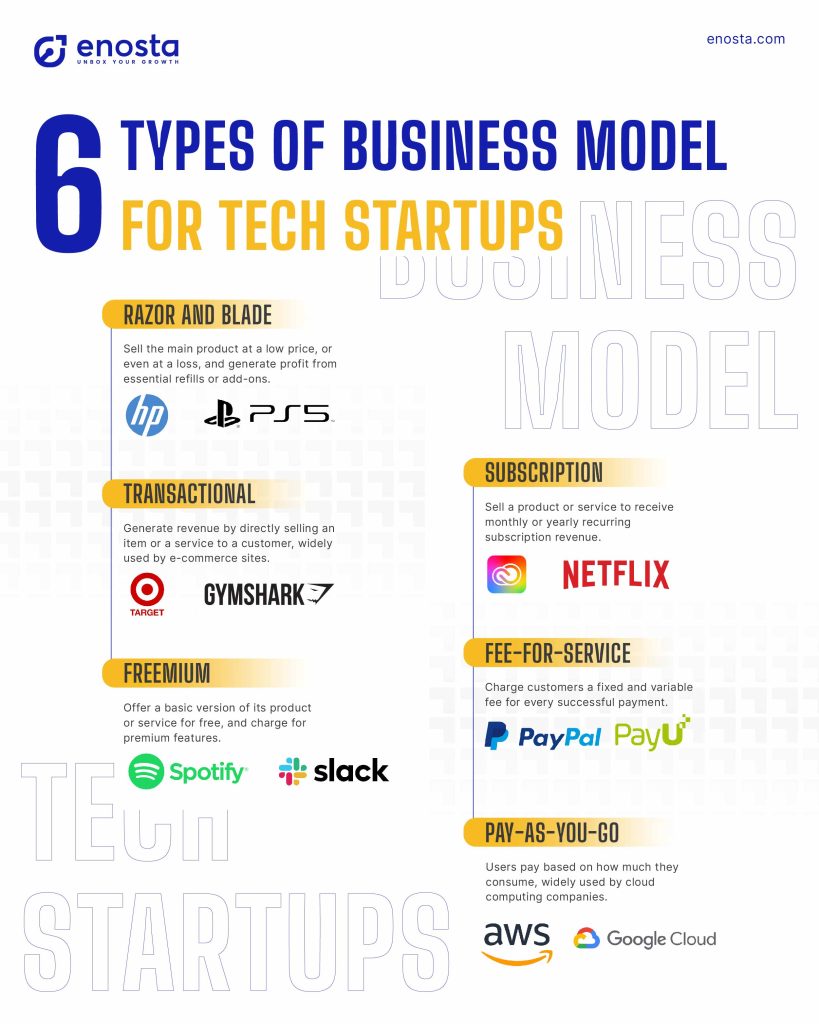
The Razor and Blade business model, or “razor-razorblade model,” is a pricing strategy in which a company sells a primary product at a low cost or even gives it away for free, but makes its profits by selling complementary features/services that are required to use or enhance the previous one. This model is named after the concept of selling razors at a low cost and making money from the ongoing sales of razor blades.
This business model requires a careful balance between 2 products. From pricing the initial product attractively to gaining a wide customer base and pricing the consumables at a point where the company can generate substantial profits over time. It also relies on creating a level of dependency on consumable products to ensure repeat purchases.
Success case using Razor and blade business model: HP, Gillette, Sony Playstation
2. Transactional Business Model
The revenue is generated by directly selling an item or a service to a customer. This model applies to a vast array of businesses and is widely used by e-commerce sites. Advantages of the Transactional Model include:
- Simplicity: Easy to understand and implement. There’s no complex subscription setup or recurring billing involved.
- Flexibility: You can cater to a wider audience by offering a range of products or services at various price points.
- Scalability: Growth translates directly to more sales. As your customer base expands and you generate more transactions, your revenue increases.
Examples: GymShark, Target
3. Freemium Business Model
The “freemium” business model is a pricing strategy applied by many software companies. The term itself is a combination of “free” and “premium.” In this model, a company offers a basic version of its product or service for free, while also providing a more advanced or feature-rich version that customers can access by paying a premium subscription or purchasing additional features. You can see its similarity with Razor and blade revenue model but custom for digital products.
Here’s how the freemium model typically works:
- Free Version (Basic): Companies offer a minimal version of their product that provides basic functionality or limited features for free. This free version is often used to attract a wide user base and generate interest in the product.
- Premium Version (Paid): Go along with the free version, the company offers a premium or “pro” version that offers advanced features, enhanced functionality, or additional services. This premium version is typically available through a subscription model or a one-time purchase.
- Value Proposition: Companies often entice users to upgrade by highlighting the benefits of the premium version, such as increased storage, advanced tools, exclusive features, enhanced customer support, and more.
- Upselling and Monetization: The goal of the freemium model is to convert a portion of the free users into paying customers. Companies use the free version to demonstrate the value of their product or service, enticing users to upgrade to the premium version for a better experience.
- Limitations of Free Version: The free version typically has limitations that encourage users to upgrade. For example, it might include ads or have storage restrictions
- User Growth and Virality: Offering a free version can help drive user adoption and grow the customer base. Satisfied free users may become ambassadors, and recommend the product to others, leading to organic growth through word-of-mouth.
Popular examples of companies using the freemium model include:
Spotify: Spotify offers a free version with ads and limited skipping. With the premium version, users can have ad-free listening, offline downloads, and more control over playback.
Evernote: Offer a basic free version with limited note syncing across devices, while the premium version offers features with advanced search, additional storage, and unlimited sync
The freemium model can be an effective way for companies to attract a wide audience, demonstrate the value of their product, and convert a large group of free users into paying customers
Read more: Startup Funding Guideline
4. Subscription Business Model
The subscription business model has gained significant popularity in recent years, particularly in industries such as software, entertainment, e-commerce, etc. This model provides a predictable revenue stream for businesses and often brings customers a convenient way to approach products without a large upfront cost. Here are the key benefits of the subscription business model:
- Recurring Payments: Instead of a one-time purchase, customers commit to paying a recurring fee for a period of time, such as monthly, quarterly, or annually.
- Customer Retention and Loyalty: Subscribers are more likely to continue using a product or service over time due to the ongoing relationship and investment they’ve made.
- Predictable Revenue: Businesses can forecast their revenue more accurately due to the consistent stream of subscription payments.
- Upselling and Cross-Selling: Businesses can offer tiered subscription plans with different levels of features or benefits, encouraging customers to upgrade. Cross-selling additional products or services within the subscription can also boost revenue.
- Churn Management: This is about the churn rate at which subscribers cancel their subscriptions. Businesses need to manage this rate by consistently delivering value, maintaining product quality, and resolving customer concerns.
- Flexible Pricing: Subscription models can offer different pricing for each customer segment, from basic plans with limited features to premium plans with more comprehensive offerings.
- Trial Periods: Many subscription services offer free trials to attract new customers and allow them to experience the product or service before committing to a paid subscription.
Netflix is an example of a subscription-based business model. It offers subscription-based access to a vast library of movies and TV shows through its streaming platform.
Or Adobe Creative Cloud which provides subscription access to Adobe’s suite of creative software tools, like Photoshop, Illustrator, and Premiere Pro
5. Fee-for-service Business Model
The fee-for-service business model is a simple way of charging customers for the specific services or products they require. It’s commonly used in various industries, such as healthcare, consulting, legal services, and more.
The process of the Fee-for-service business model
- Services or Products listing: The business offers a different range of services or products that customers can choose from based on their needs.
- Usage or Selection: Customers select the specific services or products they demand, and the business provides them accordingly.
- Payment: The business charges customers a fee that is customized for each service or product they acquire. The fee is typically based on the quantity or complexity of the service or product.
Advantages of the fee-for-service business model
- Customization: Customers only pay for what they use. Allowing them to reduce the cost by only purchasing to their specific needs.
- Flexibility: The business can adjust pricing based on market demand which can increase the selling opportunity
- Direct Revenue: Revenue is directly tied to the volume of services or products delivered, providing a clear correlation between effort and gain.
- Clear Value Proposition: Customers understand what they are paying for and can evaluate the cost against the benefits received.
However, there are also potential drawbacks to this model:
- Variable Revenue: Revenue can change based on customer demand, which can impact unpredictable income.
- Limited Recurring Revenue: This model may not provide consistent recurring revenue, leading to long-term financial stability.
Businesses applying the fee-for-service model should carefully analyze their market, target customers, and pricing strategy to make sure they can balance revenue generation effectively.
For examples: Salesforce, Adobe, Netflix
6. Pay-as-you-go (PAYG) Business Model
This is a pricing strategy where users pay based on how much they consume. It is widely used by cloud computing companies.
Here’s how it works:
- Customers Avoid Upfront Commitments: Unlike subscriptions, PAYG eliminates the need for lengthy contracts or upfront fees. Users only pay when they utilize the product or service.
- Billing Based on Usage: Businesses define a unit of measurement (e.g., storage space, processing power, minutes used) and charge customers based on their consumption within that unit.
- Flexibility and Scalability: This model caters to a wider range of users, from occasional users to high-volume consumers. Businesses benefit from automatic scaling as usage increases.
Example: Google Cloud Platform (GCP), Amazon Web Service (AWS)
Find Your Suitable Business Model With a Lean Startup Canvas
The Lean Canvas is a popular business model used by many Unicorn startups. It helps outline and plan the key elements of a startup business in a minimal way. Similar to Business Model Canvas, Lean Canvas is customised to apply for startups and support early adopters to come up with solutions apparently
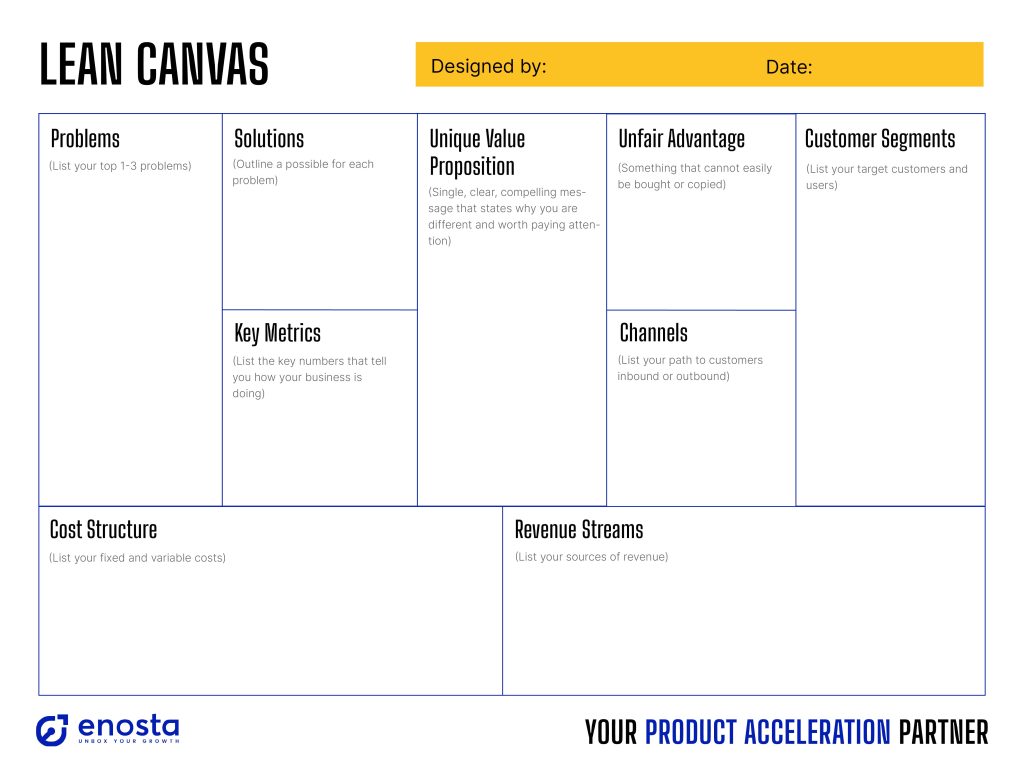
By filling out this template, you will have an overview of your startups and quickly validate your idea. This is a good start to come up with informed decisions
The 3 Pillars of the Startup Business Model
Your business model should be grounded in 3 key pillars: creating, delivering, and capturing value. These pillars drive growth and form the backbone of your business operations.
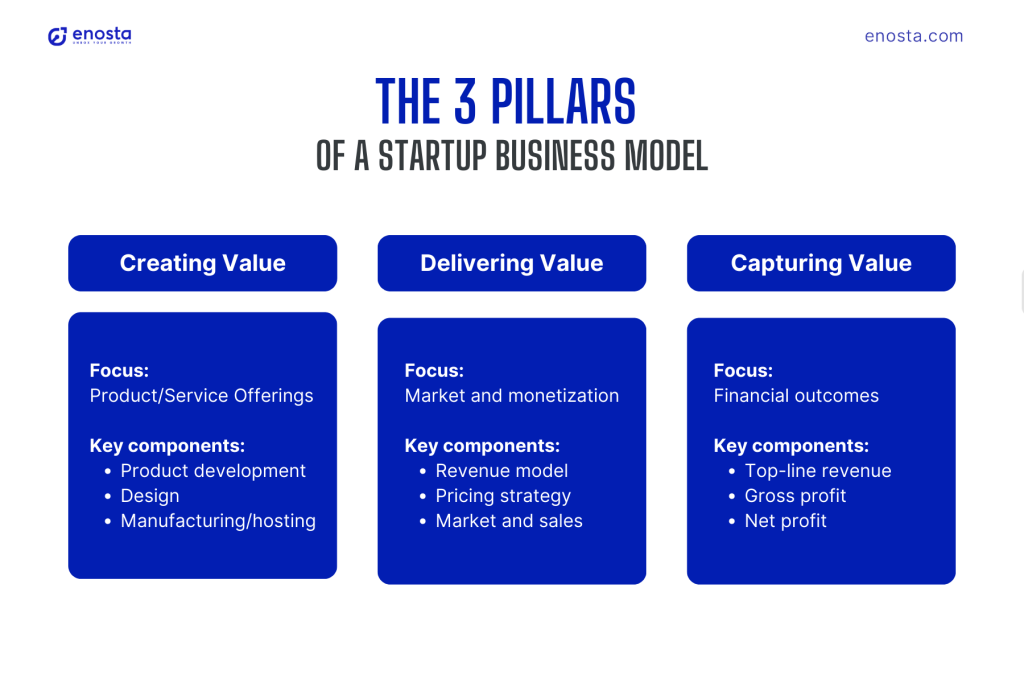
- Creating value is about what you offer customers in a product or service. It involves product development, design, hosting/manufacturing costs, and support and delivery teams. The main cost driver here is building and maintaining your offering.
- Delivering value focuses on how you bring your product or service to market and monetize it, including your revenue model, pricing strategy, marketing, and sales efforts. This pillar balances selling costs with revenue-generation strategies.
- Capturing value represents the financial outcomes of your activities. This pillar is measured by top-line revenue, gross profit and gross margin, and net profit. It’s the result of executing the first two pillars. This is where you see the tangible financial results of your value creation and delivery efforts.
Final Thoughts
“The same products, services or technologies can fail or succeed depending on the business model you choose. Exploring the possibilities is critical to finding a successful business model.”
Alex Osterwalder – Creator of Business Model Canvas.
By carefully considering your target market, value proposition, revenue streams, and cost structure, you can create a strategy that maximizes your potential for success.
At Enosta, we offer a comprehensive suite of services to guide you from conception to market.
Our team can provide expert guidance in Product Ideation & Design, Product Development, Digital Marketing, and Go-to-market strategy.
We will work closely with you to understand your unique goals and challenges, ensuring that your product meets the highest standards of quality and innovation, and brings the best for your startups.
Contact us to discuss more!